 TracePatent claim analysis
What does your IP actually protect?
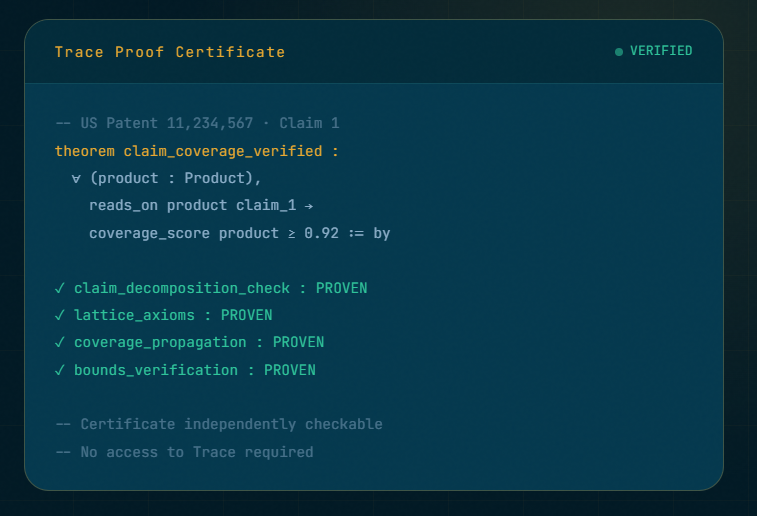
Trace breaks claims into elements, maps each one to cited product evidence, and checks the claim graph. Eligible analyses can export a Lean 4 certificate for a named proposition.
Formal results are conditional on the encoded claim graph, supplied mappings and scores, selected thresholds, definitions, and evidence. Trace supports professional review; it does not determine a legal conclusion.
Patent analysis combines professional judgment with structured computation.
Every tool gives you a probability, a score, a confidence level. These are useful approximations, but in litigation, licensing, and FTO, approximations have consequences.
Typical time to manually produce one claim chart for a single product target. Per patent. Per product version.
Eligible analyses can include a Lean 4 certificate for a named proposition over explicit premises.
Legal judgment remains essential. Trace supports it with structured evidence and reviewable computation.
Trace shows what was inferred, and checks what can be checked.
Trace proposes a structured claim graph and candidate mappings from claim limitations to cited product evidence. Reviewers can confirm, revise, or reject the decomposition and mappings before downstream checks.
Trace applies recorded dependencies, weights, scores, and thresholds consistently across the encoded graph. Structural checks can identify missing fields, invalid dependencies, and out-of-range values.
For an eligible coverage-core analysis, Trace can produce a Lean 4 certificate showing that the named coverage proposition follows from the encoded inputs. The certificate is meaningful only within its stated premises, definitions, imports, and axiom policy.
Trace can compare how recorded results change under selected claim constructions, thresholds, or term representations, and can flag supplied representations that diverge across a portfolio.
Trace can structure function-way-result mappings, prosecution-history inputs, and related evidence for attorney review. Semantic mappings, legal scope, and estoppel analysis remain outside the formal guarantee.
A hybrid workflow with an explicit trust boundary.
AI-assisted extraction proposes claim elements, dependencies, and evidence mappings.
A qualified user confirms or revises legally and semantically consequential inputs.
Deterministic and formal components evaluate the recorded structure and named propositions.
The export shows evidence, inputs, versions, checks, assumptions, limitations, and review status.
The trust each output carries.
Built for patent professionals.
Pre-litigation assessment
Produce a reviewable draft claim analysis with cited evidence and recorded assumptions.
Freedom-to-operate research support
Organize potential blocking claims, evidence gaps, sensitivity, and issues for counsel.
Portfolio consistency
Identify candidate terminology and representation differences for professional review.
Licensing and diligence
Compare claim-level evidence and conditional computations across selected assets.
Move from opaque output to reviewable analysis.
Bring a representative claim and product evidence set. See the claim graph, trust boundary, checks, and assurance record.
Trace provides technology-assisted research and analysis. It does not provide legal advice, determine infringement or non-infringement, or replace review by qualified counsel. A formal certificate, when available, establishes only that the stated proposition follows from the encoded premises in the specified proof environment. Formal results are conditional on the encoded claim graph, supplied mappings and scores, selected thresholds, definitions, and evidence. Trace supports professional review; it does not determine a legal conclusion.