 AtlasResearch expertise intelligence
What do your people actually know?
Atlas turns grants, publications, patents, and approved institutional records into evidence-linked expertise profiles, so research teams can find candidates, build teams, and document the why.
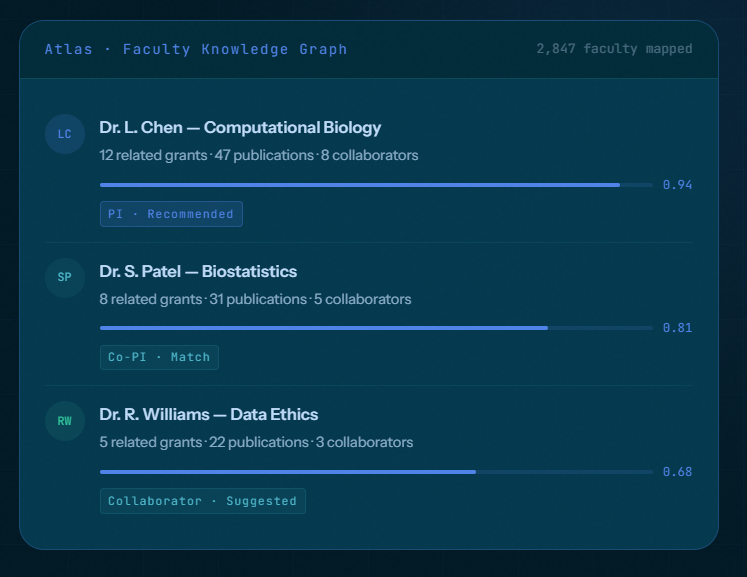
Institutional expertise is the most valuable data nobody can access.
Faculty expertise lives in siloed HR systems, grant databases, CV PDFs, and the personal networks of a few senior administrators. The result: the best person for a grant team might be two floors away, and nobody knows.
Typical time to manually identify and vet qualified faculty for a competitive grant team at a research university.
Faculty expertise scattered across HR records, grant databases, publication APIs, and personal networks, none of it connected.
Most grant team assembly still relies on personal networks. The best candidate for a role is often invisible to the team assembling it.
From scattered records to reviewable recommendations.
Connect people to grants, publications, patents, collaborations, CVs, and approved institutional records.
Generate candidate PI, Co-PI, and collaborator recommendations with cited evidence and estimated relevance.
Check configured requirements, roles, affiliations, dates, conflicts, and capability coverage.
Compare how a hypothetical capability could change documented coverage; label scenario results as estimates.
Create review-ready coverage maps and route external requests to evidence-linked candidates.
An expertise score is an estimate, not a fact.
Atlas separates the evidence record from the relevance model. Users can inspect the grants, publications, patents, collaborations, and approved records behind a recommendation, together with the scoring factors, source dates, and unresolved identity questions.
Linked to its origin and date.
Confirmed, ambiguous, or needs review.
Checked against configured rules.
Estimated.
Selection, hiring, funding, and accreditation decisions are human-owned.
The trust each output carries.
Where teams put Atlas to work.
Grant strategy
Develop evidence-backed candidate teams and review requirement coverage.
Hiring strategy
Compare documented capability gaps and candidate scenarios without automating the decision.
Program review
Map learning outcomes to evidence-linked expertise and prepare supporting documentation.
Partnership routing
Identify candidates for industry and government requests with sources visible.
Map your institution's expertise, with the evidence in view.
Request a demonstration using a representative opportunity, approved data sources, and your institution's review rules.
Atlas provides decision support. Rankings and recommendations should not be used as the sole basis for employment, promotion, funding, accreditation, or other consequential personnel or institutional decisions.